|
|
[QUE/SM-04022 ] SM-PROBLEMNode id: 5147page24. Find the number of microstates of a particle in a box of volume $V$ and having energy between $U$ and $U\,+\,\Delta U$ if the relation between energy $E$ and the momentum $p$ is given by $ E\,=\,Cp^n$, where $C$ and $n$ are constants.
|

|
22-01-09 20:01:49 |
n |
|
|
[QUE/EM-05002] --- EM-PROBLEM --- Parallel plate capacitor partially filled with dielectric slabNode id: 2243pageA large parallel plate capacitor has a potential \(V\) applied across its plates. A slab of dielectric with dielectric constant \(\kappa\) fills 9/10 of the gap between its plates with air \((\kappa_\text{air} = 1)\) filling the remaining space. Find the resulting electric field in the air and in the dielectric between the capacitor plates as well as the capacitance. Assume a separation \(t\) between the plates.
Vanderlinde
|

|
22-01-09 19:01:49 |
n |
|
|
[QUE/EM-01004] --- EM-PROBLEMNode id: 2622pageA gold nucleus contains a positive charge equal to that of 79 protons. An $\alpha$ particle, $Z=2$, has kinetic energy $K$ at points far away from the nucleus and is traveling directly towards the charge, the particle just touches the surface of the charge and is reversed in direction. relate $K$ to the radius of the gold nucleus. Find the numerical value of kinetic energy in MeV is the radius $R$ is given to be $5 \times10^{-15}$ m.
[ 1 MeV = $10^6$ eV and 1 eV = $1.6\times10^{-16}$]
|
|
22-01-09 18:01:45 |
n |
|
|
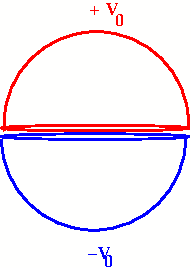
[QUE/EM-06009] --- EM-PROBLEM --- Conducting sphere with hemispheres at different potentialsNode id: 3030page
| A conducting shell is formed by joining two hemispheres with a thin insulating material in between, The northern hemispheres is kept at potentials \(V_0\) and the southern hemisphere is kept to potential \(-V_0\). Find the potential distribution inside the shell. |
 |
PUBLIC
|
|
22-01-09 18:01:31 |
n |
|
|
[QUE/EM-07013] --- EM-PROBLEM --- Torque on current loopin magnetic fieldNode id: 3025pageA circular coil is formed from a wire of length $L$ with $n$ turns. The coil carries a current $I$ and is placed in an external uniform magnetic field $B$. Show that maximum torque developed is $\displaystyle\frac{IBL^2}{4n\pi}$.
|
|
22-01-09 18:01:55 |
n |
|
|
[QUE/EM-05009] --- EM-PROBLEM Node id: 2381pageA dipole is embedded at the center of a sphere of linear dielectric material ( with radius \(R\) and dielectric constant \(\epsilon_r\) ). Show that the electric potential inside and outside the sphere is
\[ \Phi(r) = \begin{cases} \frac{p\cos\theta}{4\pi \epsilon r^2}\left( 1+ 2 \frac{r^3}{R^3}\frac{(\epsilon_1-1)}{(\epsilon_r+2)}\right) & r \le R \\ \frac{p\cos\theta}{4\pi \epsilon_0 r^2} \left(\frac{3}{\epsilon_r+2}\right)& r \ge R\end{cases} .\]
|
|
22-01-09 18:01:01 |
n |
|
|
[QUE/EM-06008] --- EM-PROBLEM --- Spherical cavity in a mediumNode id: 3028pageA uniform electric field \(E_m\) is set up in a medium of dielectric constant \(\kappa\). Prove that the field inside a spherical cavity in the medium is given by \begin{equation*} E = \frac{3\kappa E_m}{2\kappa+1} \end{equation*}
|
|
22-01-09 18:01:56 |
n |
|
|
[QUE/SM-07003] SM-PROBLEMNode id: 5150pageShow that the internal energy of a material whose equation of state is of the form
$$ P\,=\,f(V)T $$
is independent of the volume V. ( P,T are pressure and temperature)
|
|
22-01-07 20:01:55 |
n |
|
|
[QUE/SM-04003] SM-PROBLEMNode id: 3236pageThe canonical partition function of a system of $N$ hypothetical particles each of mass $m$, confined to a volume $V$ at temperature $T$ is given by, $$Q(T,V,N) = V^N\left(\frac{2\pi k_B T}{m}\right)^{5N/2}.$$ Determine the equation of state of the hypothetical system. Also find $C_V$ - heat capacity at constant volume. Identify the hypothetical system. How many degrees of freedom does each particle of the hypothetical system have ?
KPN
|
|
22-01-07 12:01:01 |
n |
|
|
[QUE/SM-10005] SM-PROBLEMNode id: 3268pageObtain \(c_p\) for the ideal Bose gas for \(T > T_c\) . Show that ( for \(T > Tc\)) \[\frac{c_p}{c_v} = \frac{ 5 g_{5/2}(z) g_{1/2}(z)} {3 (g_{3/2}(z))^2}\]
HSMani
|
|
22-01-07 12:01:27 |
n |
|
|
[QUE/SM-04006] SM-PROBLEMNode id: 3239pageThere are three single particle quantum levels : a non degenerate ground state of energy zero and a doubly degenerate excited state of energy $\epsilon=10k_B \ln 18$ joules. Non-interacting particles obeying Maxwell-Boltzmann statistics occupy these three quantum levels. The closed system is described by a canonical ensemble at temperature $T$. Find the temperature below which more than $90$ percent of the particles would be found in the ground state.
KPN
|
|
22-01-07 12:01:59 |
n |
|
|
[QUE/SM-04009] SM-Problem Node id: 3243pageA zipper has two links one ( open) has energy 0 and one (closed) has energy $\Delta$. Label the links as 1,2,...,s,.... The s th link can open only if all the links 1,2, ---,(s-1) are open. Assuming the system is in thermal equilibrium at temperature T, find the canonical partition function. Find the average number of open links for $T\,\rightarrow\,\infty$.
|
|
22-01-07 12:01:33 |
n |
|
|
[QUE/SM-04010] SM-Problem Node id: 3244pageConsider N point particles inside a box of volume V and at temperature T. The energy function is given by $$ H\,=\,\frac{p^2}{2M}\,+\,V(|\vec{r}_i\,-\,\vec{r}_j|) $$ where $$ V(r) \,=\,0 \qquad\rm{for}\,r\,>\,a$$ $$ =\,\infty\qquad \rm{when}\, r\,<\,a $$ Calculate the canonical partition function $Z_c$ and show that $$ Z_c\,=\,\frac{1}{N!}\left(\frac{2\pi m k T}{h^2}\right)^{3/2} Q $$ where $$Q\,=\,V^N\left(1\,-\,\frac{4\pi a^3}{3}\frac{N(N+1)}{2V}\right) $$ with correction of order $V^{(N-2)}$. Evaluate the corrections to $PV\,=\,NkT$ to the next non vanishing order.
HSMani
|
|
22-01-07 12:01:10 |
n |
|
|
[QUE/SM-04012] SM-PROBLEM Node id: 3246pageConsider a spin 1/2 system at temperature T with the Hamiltonian $$H\,=\,A_1 S_3\,-\mu B_0 S_1 $$ where $B_0$ is an external magnetic field. Find the magnetization as a function of (a)temperature and (b) $B_0$.
HSMani
|
|
22-01-07 12:01:28 |
n |
|
|
[QUE/SM-04013] SM-PROBLEMNode id: 3247pageA box of volume, \(V = L^3\) , contains an ideal gas of \(N\) identical atoms, each of which has spin, \(s = 1/2\), and magnetic moment, \(\mu\). A magnetic field, \(B\) is applied to the system. (a) Compute the partition function for this system. (b) Compute the internal energy and the heat capacity. (c) What is the magnetization?
|
|
22-01-07 12:01:06 |
n |
|
|
[QUE/SM-04014] SM-PROBLEMNode id: 3248pageConsider an ideal gas of N particles ( mass M) obeying Maxwell- Boltzmann distribution is at temperature T. Calculate the (a) the average energy of a particle $e\,=\,\frac{<E>}{N}$ and (b) the root mean square deviation $\sqrt{\frac{<E^2>}{N}-e^2} $
HSMani
|
|
22-01-07 12:01:26 |
n |
|
|
[QUE/SM-04016] SM-PROBLEMNode id: 3256pageThe internal energy density u of a gas is function of T only and further $$ P\,=\,\frac{1}{3}u(T) $$. Find the functional form of $u(T).$
HSMani
|
|
22-01-07 12:01:57 |
n |
|
|
[QUE/SM-06002] SM-PROBLEMNode id: 3224pageConsider a system in touch with a reservoir with which exchanges energy and volume ( a movable piston is attached to the system.). Find the partition function $Z_{V}$. Find the thermodynamic function $ -k T\,\rm{ln}(Z_V) $.
|
|
22-01-07 12:01:35 |
n |
|
|
[QUE/SM-06005] SM-PROBLEM Node id: 3222pageCalculate the fluctuation in energy $(\overline{\Delta E})^2\,=\,\overline{E^2}\,-\,\overline{E}^2$ for the grand canonical ensemble. You may find the equations ( derive them!) useful: $$\overline{\Delta E})^2\,=\,-\left(\frac{\partial\overline{E}}{\partial\beta}\right)_{\mu,V}\,+\,\frac{\mu}{\beta}\left(\frac{\partial \overline{E}}{\partial \mu}\right)_{T,V} $$ $$ \left(\frac{\partial \overline{E}}{\partial T}\right)_{\mu,V}\,=\,\left(\frac{\partial \overline{E}}{\partial T}\right)_{\overline{N},V}\,+\,\left(\frac{\partial \overline{E}}{\partial\overline{N}}\right)_{T,V}\left(\frac{\partial \overline{N}}{\partial T}\right)_{\mu,V} $$ $$ \left(\frac{\partial \mu}{\partial T}\right)_{\overline{N},V} \,=\,-\frac{\left(\frac{\partial \overline{N}}{\partial T}\right)_{\mu,V}}{\left(\frac{\partial \overline{N}}{\partial \mu}\right)_{T,V}} $$ The Maxwell's relation $$ \left(\frac{\partial\mu}{\partial T}\right)_{\overline{N},V}\,=\,-\left(\frac{\partial S}{\partial \mu}\right)_{T,V} $$ Also the relation derived in class ( you can assume this ) $$ \overline{\Delta N^2}\,=\,\left(\frac{\partial\overline {N}}{\partial\mu}\right)_{T,V} $$
|
|
22-01-07 12:01:09 |
n |
|
|
[QUE/SM-06006] SM-PROBLEM Node id: 3223pageObtain the entropy of an ideal gas ( classical) using the grand canonical ensemble and show it is identical to the one obtained from micro canonical ensemble.
|
|
22-01-07 11:01:27 |
n |



 ||Message]